
Axis Bank emerged as the biggest gainer in the Sensex pack, surging 6.62 per cent, followed by SBI at 5.88 per cent.

Mutual funds (MFs) turned net sellers of equities in April amid a run up in stock prices on sustained inflows from foreign portfolio investors (FPI). The benchmark indices, Sensex and Nifty50, logged their biggest monthly advance since November last year, gaining 3.6 per cent and 4.1 per cent last month. Data from the Securities and Exchange Board of India (Sebi) shows that MFs sold equities worth over Rs 5,100 crore in April, the highest since February 2021.

From the Sensex pack, Maruti, Axis Bank, Tata Consultancy Services, Nestle, Infosys, Mahindra & Mahindra, Tech Mahindra and Bharti Airtel were the major laggards. Power Grid, Sun Pharma, HCL Technologies, Larsen & Toubro and UltraTech Cement were the gainers.

The rupee plunged 90 paise to close at an all-time low of 80.86 (provisional) against the US dollar on Thursday after the US Federal Reserve's interest rate hike and its hawkish stance weighed on investor sentiments. Forex traders said the US Fed's rate hike and escalation of geopolitical risk in Ukraine sapped risk appetite. Moreover, the strength of the American currency in the overseas market, a muted trend in domestic equities, risk-off mood and firm crude oil prices weighed on the rupee.

BSE mid-cap index slipped 0.6% at 6,266. Small-cap index held on to gains and traded unchanged at 6,034.

Asia would become a major hub for corporate and investment banking in five years, according to a report released by McKinsey.

Fitch Ratings on Thursday retained India's growth forecast for the current fiscal at 6.3 per cent citing economic resilience despite tighter monetary policy and exports weakness, but upped year-end inflation projection on El Nino threat. The Indian economy grew 7.8 per cent in the April-June quarter of current fiscal on strong services sector activity and robust demand. "The Indian economy continues to show resilience despite tighter monetary policy and weakness in exports, with growth outpacing other countries in the region," Fitch said, while projecting 6.3 per cent growth for current fiscal (April-March), and 6.5 per cent for next fiscal.

Indian equity markets had a good run in the first half of calendar year 2023 (CY23), with the S&P BSE Sensex and the National Stock Exchange Nifty50 hitting fresh 52-week highs. While the Sensex scaled up to a peak 64,718, the Nifty50 hit Mt 19,189. As the markets now prepare to enter the second half (H2) of CY23, all eyes are on global central banks, especially the US Federal Reserve, as to when they will pause and pivot as regards their interest-rate cycle.

"China creeps towards hegemony in Asia, threatens India's borders, and treats other countries as junior partners, Indian-American Congressman Ro Khanna said.

In the Sensex pack, Mahindra & Mahindra, Tata Steel, Tata Motors, Maruti, Larsen & Toubro, HDFC, HDFC Bank, Tech Mahindra and Bharti Airtel were the major laggards. Asian Paints, Bajaj Finserv, Power Grid, Reliance Industries, NTPC and UltraTech Cement were among the gainers.

BSE Realty index and BSE Bankex indices surged by over 2%.

While India won't be immune to global spillovers, we need to create the macro preconditions for sustained growth. Policy agility, prudence, and resilience will be key, suggests Sonal Varma.

After the recent attack on debit cards exposed the gaps in their security systems, banks are getting serious about data privacy.

Policymakers should aspire to restore the pre-Independence environment where the rupee was trusted and used all over South Asia, in Southeast Asia, in West Asia, and in East Africa, suggests Ajay Shah.

With a 'tilak' on his forehead and a 'puja thali' in his hands, Shinzo Abe's picture attending the 'Ganga aarti' alongside Prime Minister Narendra Modi at the fabled Dashashwamedh Ghat in Varanasi in 2015 symbolised his 'India connect' and reflected the very special bond he shared with the country.
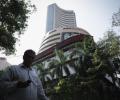
From the Sensex firms, Tech Mahindra jumped 5.58 per cent, followed by Nestle, Tata Steel, NTPC, Tata Consultancy Services, Asian Paints, Wipro and Bajaj Finserv. Mahindra & Mahindra, Hindustan Unilever, Axis Bank and Bajaj Finance were among the major laggards.

Benchmark BSE Sensex rose by 319 points on Monday on gains in IT and financial stocks after positive quarterly results amid supportive global cues. The 30-share BSE barometer rose by 319.90 or 0.53 per cent to close at 60,941.67. The index opened higher and gained more than 400 points to scale the 61,000 level. It touched a high of 61,113.27 and a low of 60,761.88 in the day.
In the Sensex pack, other gainers were Bajaj Finance, Bharti Airtel, Tata Motors, Hero MotoCorp, HUL, Asian Paints, HDFC duo and ONGC -- gaining as much as 2.87 per cent.

Kotak Mahindra Bank was the biggest gainer on both the indices, ending nearly 9 per cent higher following reports that Warren Buffett's Berkshire Hathaway Inc was planning to pick up stake in the private sector lender.

Japanese telecom major would invest $50 mn in the start-up in 'December or latest by January'.

Life Insurance Corporation of India, Housing Development Finance Corporation and State Bank of India together own a little over 45 per cent in IL&FS. The deal is expected to be valued around $2.5 billion.

Equity markets would be mainly driven by global trends and foreign fund trading activity in the holiday-shortened week, analysts said. The BSE and the National Stock Exchange have listed March 7 (Tuesday) as a holiday on account of Holi. However, stock brokers' association ANMI has urged the government, exchanges and Sebi to shift the holiday to March 8 from March 7.

As India's stock rises, the resolution of the border row may become even more difficult, warn Harsh V Pant and Kalpit Mankikar.

The country's per capita income is likely to grow by close to 70 per cent to $4,000 by fiscal 2030 from $2,450 in fiscal 2023, helping it become a middle-income economy with $6-trillion GDP, more than half of which will be coming in from household consumption, says a research report. Per capita income/GDP has risen from $460 in fiscal 2001 to $1,413 in fiscal 2011 and further to $2,150 in fiscal 2021. The biggest growth driver will be external trade which may nearly double to $2.1 trillion by 2030 from $1.2 trillion in fiscal 2023 when the GDP printed in at $3.5 trillion, Standard Chartered Bank said in a weekend report which assumes a 10 per cent nominal GDP growth annually from now on.

Licence winners are expected to be announced by the first quarter of 2014.

IndusInd Bank was the top gainer in the Sensex pack, spurting over 5 per cent, followed by Bajaj Finserv, HCL Tech, Bajaj Finance, Kotak Bank and Axis Bank. NSE Nifty jumped 203.15 points to 17,780.00.

From the Sensex pack, Tata Motors, Sun Pharma, Wipro, Tata Consultancy Services, UltraTech Cement, Tech Mahindra, Bajaj Finserv, HCL Technologies, Infosys and IndusInd Bank were the major laggards. NTPC, Power Grid, Reliance Industries, Tata Steel, HDFC and HDFC Bank were the major winners.

The NSE Nifty settled the day 38.85 points or 0.37 per cent lower at 10,500.90 after shuttling between 10,590.55 and 10,456.65, intra-day.

According to Trend Micro's January-March, 2014 Threat Round Up, as law enforcement agencies are slowly being ramped up, cyber criminals are adding more layers to ensure anonymity to conceal their identities to avoid arrest.

Equity indices overcame a wobbly start to clock gains for the third session on the trot on Tuesday, propped up by banking, metal and energy stocks amid a mixed trend in global markets. A recovery in the rupee also bolstered sentiment, traders said. The 30-share BSE Sensex advanced 246.47 points or 0.45 per cent to settle at 54,767.62 after starting the trade on a weak note. In a volatile session, the benchmark hit a high of 54,817.52 and a low of 54,232.82 during the day.

Nikesh Arora is indeed paid a lot, networks hard, and has made some punchy bets.

Benchmark Sensex rallied 455 points and Nifty rose more than 133 points to close above the key 18,000-mark for the first time since April on Tuesday as foreign institutional investors continued to be bullish on the domestic market. Continuing its rally for the fourth straight session, the 30-share Sensex rose 455.95 points or 0.76 per cent to close at 60,571.08 points. The broader Nifty climbed 133.70 points or 0.75 per cent to settle at 18,070.05 points. Previously, the Nifty had closed above the 18,000-mark on April 4 this year.

The rupee depreciated 44 paise and slipped below the 81-mark against the US dollar for the first time in early trade on Friday, weighed down by the strong american currency and risk-off sentiment among investors. Forex traders said escalation of geopolitical risk in Ukraine and rate hikes by the US Fed and Bank of England in a bid to contain inflation sapped risk appetite. Further, the strength of the American currency in the overseas market, a negative trend in domestic equities, and risk-off moods amid escalation of geopolitical risk in Ukraine weighed on the local unit.

India is in a much better position to deal with the challenges related to growth and inflation, said Sanjiv Bajaj, president of industry body CII. According to official figures, India's retail inflation continues to remain above the Reserve Bank's tolerance level of 6 per cent since January, while the economic growth in the first quarter of the fiscal was 13.5 per cent, lower than the central bank's estimate of 16.2 per cent. "I don't want to say we don't have our own challenges with growth, with inflation but we are in a much better position and credit must go to everybody including the central and state governments.

Foreign investment in India's start-ups has plummeted 72 per cent to $4.58 billion so far, from $16.2 billion during the same period last year.

The venture is seen as a rival to the World Bank.

'There is a law that prevents the government from diluting its equity in the PSBs below 50 per cent.' 'That law has to be amended and given the parliamentary arithmetic of the political parties, it is not as simple to do that.'
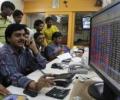
Markets ended lower for the third straight day on Tuesday weighed down by profit taking in rate sensitives with bank shares leading the decline after hopes of rate cut by the central bank faded.
